
A conveyor bearing can appear to be working normally during one inspection and cause an unexpected stoppage later. That situation often creates the impression that Conveyor Bearing Failure happened without warning. In reality, bearing damage usually develops through a combination of small changes that are difficult to notice during ordinary operation.
A bearing does not work alone. It supports rotating components, handles loads transmitted through the conveyor structure, and operates within an environment that may contain dust, moisture, heat, vibration, or material debris. Its condition can also be affected by shaft alignment, mounting quality, lubrication, loading changes, and the condition of surrounding components.
The difficult part is not understanding that bearings wear. The difficult part is recognizing when normal wear has started turning into a developing mechanical problem.
Why Can A Bearing Problem Appear So Suddenly?
Bearing damage is usually progressive, but the visible symptoms do not always progress at the same pace.
A small change inside a bearing may not immediately produce a noticeable sound. A slight increase in friction may remain hidden during a short inspection. A seal can lose effectiveness before contamination becomes visible from outside. Alignment can change gradually as a structure settles or a mounting connection changes.
These conditions can develop while the conveyor continues operating.
The result is a gap between the beginning of bearing degradation and the moment when an operator recognizes that something is wrong.
That gap explains why a bearing can seem healthy during one inspection and fail unexpectedly later.
Another issue is that conveyor systems often contain many rotating components. Maintenance personnel may naturally focus on the belt, motor, drive system, or material flow because these parts are easier to observe. A bearing located inside a housing can remain out of sight until its condition has already changed significantly.
What Actually Causes Conveyor Bearing Failure?
There is rarely one universal cause.
A bearing may fail because several unfavorable conditions interact over time. Common contributors include:
- Lubrication problems
- Contamination
- Misalignment
- Excessive or changing loads
- Installation problems
- Heat buildup
- Vibration
- Seal deterioration
- Surface fatigue
- Poor inspection practices
These causes can also influence one another.
For example, contamination can affect lubricant condition. Poor lubrication can increase friction and heat. Increased heat can further degrade the lubricant. Misalignment can create uneven loading, which increases local stress and vibration.
The failure process therefore needs to be viewed as a chain rather than a single event.
| Condition | Possible Effect On Bearing |
|---|---|
| Contamination | Accelerated surface wear |
| Poor lubrication | Increased friction and heat |
| Misalignment | Uneven load distribution |
| Changing load | Additional mechanical stress |
| Poor mounting | Abnormal contact conditions |
| Excessive vibration | Progressive mechanical damage |
| Heat buildup | Lubricant degradation and material stress |
| Seal problems | Greater exposure to the operating environment |
Understanding these connections makes troubleshooting much more useful than simply replacing a failed bearing.
Lubrication Can Change The Condition Without Being Obvious
Lubrication is one of the most important factors in rolling bearing operation.
The lubricant helps separate contacting surfaces and reduce friction. However, adding lubricant is not automatically a solution to every bearing problem.
A bearing can experience trouble when lubrication is insufficient, unsuitable for the application, degraded, contaminated, or applied incorrectly. Excessive lubrication can also create problems because additional grease can increase resistance and heat generation.
This creates a practical maintenance challenge.
A bearing housing may look clean from the outside while the lubricant inside has already changed. Grease can collect contaminants, lose useful properties over time, or become affected by operating temperature.
For this reason, lubrication should be treated as part of a condition-based maintenance process rather than a simple routine task.
Maintenance personnel should consider:
- The operating environment
- The bearing application
- The condition of the lubricant
- The condition of seals
- Previous lubrication work
- Changes in operating temperature
- Any unusual noise or vibration
A consistent maintenance record can also help identify patterns that would otherwise be missed.
Contamination Is A Quiet Source Of Damage
Conveyors often operate around materials that create dust and debris. Depending on the application, moisture, process residue, fine particles, or other contaminants may also be present.
The bearing seal provides an important barrier between the internal bearing environment and surrounding conditions. When that barrier becomes damaged or loses effectiveness, contaminants can enter the bearing area.
Once abrasive particles reach the rolling contact surfaces, they can contribute to wear. Moisture can introduce another problem by encouraging corrosion or affecting lubricant condition.
Contamination is particularly difficult because it does not always create an immediate external symptom.
The conveyor may continue to run normally while internal surfaces gradually deteriorate.
A useful inspection therefore looks beyond the bearing itself. The surrounding area should also be checked for:
- Damaged seals
- Accumulated debris
- Moisture exposure
- Grease leakage
- Unusual deposits
- Damaged housings
- Loose or deteriorated protective components
If the same bearing location repeatedly experiences contamination, simply installing another bearing may not solve the underlying problem.
The surrounding mechanical environment needs attention as well.
How Does Misalignment Affect A Conveyor Bearing?
A conveyor bearing is designed to operate within a particular mechanical arrangement. When the shaft, housing, roller, pulley, or supporting structure is not properly aligned, the load distribution can change.
Instead of being distributed as intended, forces may become concentrated in particular areas.
This can create uneven contact, additional friction, vibration, and localized wear.
Misalignment can develop for different reasons. A component may not have been installed correctly. A shaft may have experienced deformation. Mounting surfaces can change over time. Structural movement can also alter the relationship between connected components.
The important point is that alignment should not be considered only during initial installation.
When a bearing repeatedly develops similar damage patterns, the surrounding alignment should be examined rather than assuming that the bearing itself was defective.
This is especially useful when a replacement bearing appears to solve the problem temporarily but the same failure returns.
Repeated failure at the same location is often a reason to investigate the complete mechanical system.
Load Changes Can Be More Important Than Average Load
Conveyor systems do not always operate under perfectly consistent conditions.
Material flow can change. Starting and stopping can introduce different forces from steady operation. Uneven loading can affect rotating components. Blockages or sudden changes in material movement can also create temporary mechanical stress.
A bearing may therefore experience a working environment that is more complicated than a simple average load suggests.
This is why bearing selection should consider the actual application rather than relying only on one basic dimension.
The conveyor arrangement, shaft, rotating component, loading pattern, operating environment, and expected mechanical conditions all form part of the selection process.
If the actual working conditions change after installation, the original bearing arrangement may also need to be reviewed.
Installation Quality Matters Before The Conveyor Even Starts
A bearing can be damaged before it completes meaningful operating service.
Improper handling, incorrect mounting force, contamination during installation, or poor alignment can introduce mechanical problems at the beginning of the bearing's service period.
Installation is therefore not simply the final step before startup. It is part of bearing reliability.
Clean working conditions are important. Bearing components should be handled carefully, and mounting forces should be applied in a manner appropriate to the bearing arrangement.
The surrounding shaft and housing should also be checked.
If a bearing repeatedly develops abnormal wear shortly after replacement, maintenance personnel should ask a wider question:
Was the replacement bearing installed correctly, and are the shaft, housing, and alignment conditions suitable?
This question can prevent repeated replacement without addressing the underlying cause.
Why Does Heat Matter?
Temperature changes can provide useful information about bearing condition.
Friction produces heat during normal operation, but abnormal friction can change the thermal behavior of a bearing. Lubrication problems, contamination, misalignment, excessive loading, and other mechanical conditions may contribute to increased heat.
The challenge is that temperature alone does not identify the exact cause.
A warmer bearing does not automatically mean the bearing itself is damaged. The surrounding conveyor structure, lubrication condition, loading pattern, and operating environment should also be considered.
This is why trend information can be more useful than a single observation.
If a bearing has operated within a relatively stable thermal pattern and then begins showing a consistent change, that difference deserves attention.
The goal is not to react to every small variation. The goal is to recognize meaningful changes in equipment behavior.
Vibration Can Reveal What Visual Inspection Misses
Some bearing problems are difficult to see.
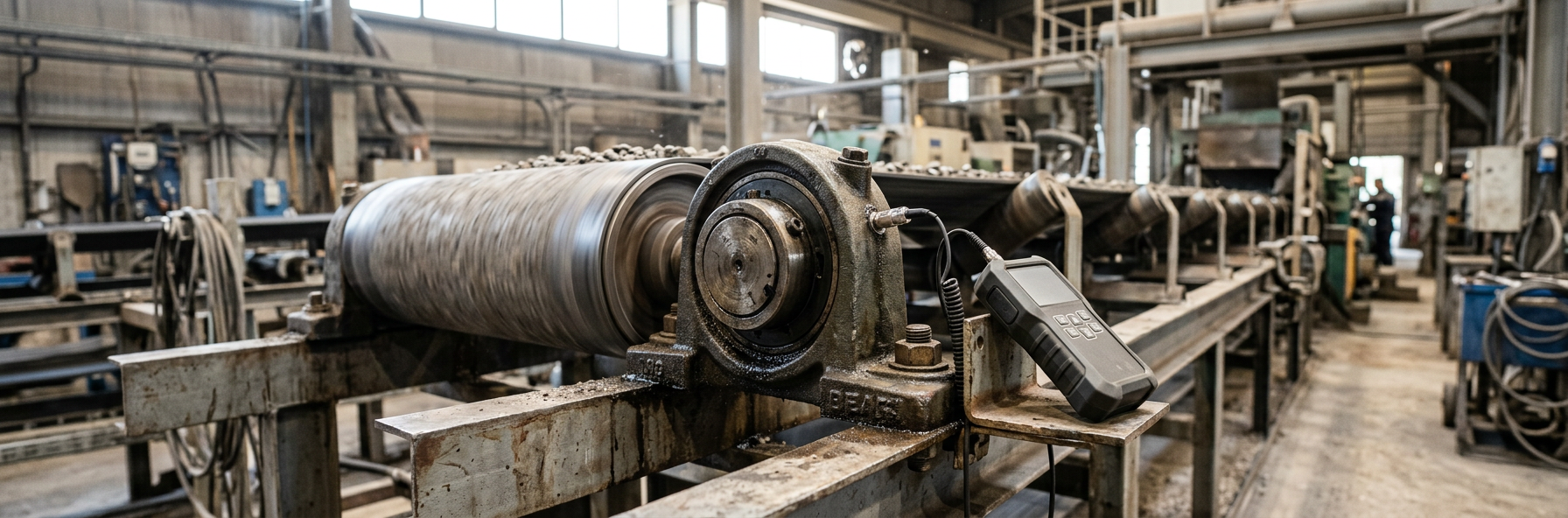
Vibration monitoring can provide another way to evaluate rotating equipment. Changes in vibration behavior may indicate wear, imbalance, looseness, contamination, alignment problems, or developing bearing damage.
The useful information often comes from the trend rather than one isolated reading.
A single unusual reading may have several explanations. Repeated changes that follow a consistent pattern can provide stronger evidence that equipment condition is changing.
For conveyor maintenance, vibration information can be considered alongside:
- Temperature
- Noise
- Lubricant condition
- Visual inspection
- Operating history
- Load changes
- Previous maintenance records
Using several forms of information helps reduce the risk of making a decision based on one symptom alone.
Noise Is Useful, But It Should Not Be The Only Warning
Operators are often familiar with the normal sound of a conveyor.
That makes changes in sound potentially useful.
A new rumbling, grinding, clicking, squealing, or irregular mechanical sound may justify closer inspection. However, waiting for a bearing to become noticeably noisy is not a reliable maintenance strategy.
Some problems develop without an obvious sound change.
Noise should therefore be treated as one part of a larger inspection process.
An operator who notices a different sound can report the location and operating condition. Maintenance personnel can then compare that observation with temperature, vibration, lubrication, alignment, and physical condition.
This approach turns an informal observation into useful maintenance information.
Why Routine Inspection Sometimes Misses Bearing Problems
Routine inspection is valuable, but a short inspection only captures equipment condition at one moment.
Imagine a bearing that is beginning to develop internal surface damage. During a brief inspection, the conveyor may be running under a light load and the bearing may not produce a noticeable symptom.
Later, operating conditions change.
The conveyor handles a different material flow. The bearing becomes warmer. Vibration changes slightly. The lubricant condition continues to deteriorate.
The problem has not appeared suddenly. The inspection simply did not capture the developing change.
This is one reason condition monitoring and maintenance records can complement physical inspections.
A useful maintenance program combines different types of information instead of depending entirely on one inspection method.
What Should Be Checked When A Bearing Fails?
Replacing the failed component may restore operation, but failure analysis should not stop there.
Before installing another bearing, inspect the surrounding system.
A practical review can include:
- Bearing condition
Look for unusual wear, discoloration, surface damage, corrosion, or lubricant changes. - Shaft condition
Check the shaft seating area and look for signs of wear, damage, or abnormal contact. - Housing condition
Inspect the bearing housing for damage, looseness, contamination, or mounting problems. - Seal condition
Determine whether the sealing arrangement provided suitable protection for the environment. - Lubrication history
Review what lubricant was used, when maintenance occurred, and whether contamination may have been present. - Alignment
Check the relationship between the shaft, housing, roller, pulley, and supporting structure. - Operating conditions
Consider recent changes in material flow, loading, operating cycles, or conveyor behavior. - Inspection records
Compare previous observations with the current condition.
This approach turns a failure into information that can improve future maintenance decisions.
A Simple Failure Investigation
| Observation | Areas To Investigate |
|---|---|
| Unusual noise | Bearing condition, lubrication, contamination, looseness |
| Rising temperature | Lubrication, alignment, load, friction |
| Increased vibration | Wear, imbalance, alignment, contamination |
| Grease leakage | Seal condition, housing condition, lubrication |
| Repeated bearing replacement | Alignment, installation, load, contamination |
| Visible corrosion | Moisture exposure, sealing, storage, environment |
| Uneven wear | Shaft, housing, alignment, loading |
| Sudden seizure | Lubrication, contamination, damage, excessive mechanical stress |
How Can Maintenance Reduce Unexpected Bearing Problems?
Good bearing maintenance is less about performing one dramatic repair and more about controlling small conditions consistently.
A practical program can include several layers.
Keep Inspection Consistent
Use a repeatable inspection process so changes are easier to identify. The same bearing location should be evaluated in a comparable way over time.
Track Changes
Record unusual temperature, vibration, noise, lubrication observations, and previous repairs. A trend can reveal information that a single inspection cannot.
Investigate Repeated Failures
If the same bearing position fails repeatedly, investigate the system around it. Replacing the component again may only remove the symptom temporarily.
Protect Against Contamination
Inspect seals and surrounding equipment, especially where dust, moisture, or process material can reach rotating components.
Review Lubrication Practices
Lubrication should match the bearing application and operating environment. Maintenance records should make it clear what work has been performed and when.
Check Alignment After Mechanical Work
Whenever a shaft, housing, roller, pulley, or supporting structure is repaired or replaced, alignment should be considered as part of the work.
Learn From Failed Components
A damaged bearing contains useful information. Wear patterns, discoloration, contamination, and surface damage can help point toward the underlying cause.
Why Bearing Replacement Alone May Not Solve The Problem
A new bearing can restore equipment operation, but it cannot correct an underlying mechanical condition.
If contamination remains, the new bearing can face the same environment.
If alignment remains incorrect, uneven loading can continue.
If lubrication practices remain unsuitable, the replacement component may experience similar deterioration.
If the conveyor is subjected to operating conditions that differ from its original design assumptions, the bearing arrangement may also need review.
This is why maintenance teams should avoid treating every bearing failure as an isolated component problem.
The bearing is part of a larger mechanical system.
What Does A Better Bearing Maintenance Strategy Look Like?
A practical strategy connects inspection, operating information, and failure analysis.
The process can be simple:
Observe → Record → Compare → Investigate → Correct → Monitor
First, observe the equipment during normal operation.
Next, record meaningful changes rather than relying entirely on memory.
Then compare current behavior with previous observations.
If a change is significant or repeated, investigate the possible causes.
Correct the underlying condition instead of focusing only on the failed component.
Finally, monitor the equipment after the correction to confirm whether the condition has stabilized.
This approach is useful because it changes the maintenance question from "Why did this bearing fail?" to "What changed before the bearing failed?"
That is a much more productive question.
The Real Reason A Conveyor Bearing Can Seem To Fail Without Warning
The idea of a completely silent bearing failure is often misleading.
The bearing may have been developing wear for some time, but the available inspection methods did not reveal the change. A small temperature increase may not have attracted attention. A subtle vibration change may have remained below practical detection. A seal problem may have developed inside an otherwise clean-looking housing.
In other cases, several small problems may have combined.
A little contamination, a change in lubrication, slight misalignment, and a demanding operating cycle can interact in ways that accelerate bearing deterioration.
That is why conveyor bearing maintenance needs to look at the entire operating environment.
Conveyor Bearing Failure is easier to understand when it is viewed as a developing mechanical condition rather than a random event. Lubrication, contamination, alignment, loading, installation, temperature, vibration, sealing, and inspection practices all influence how a bearing behaves over time.
For equipment operators and maintenance teams, the practical lesson is straightforward: do not wait for a bearing to become noisy or seize before investigating changes. Consistent observation, useful maintenance records, careful installation, suitable lubrication, and attention to surrounding mechanical conditions can make developing problems easier to recognize and address.


